
Measuring the distance to a surface at the nanometre level gets harder when the target is shiny, dark, transparent or tilted, or when the sensor has to fit inside a narrow cavity. Our confocal sensors allow the research or process engineer to measure distance, displacement and position, and the thickness of transparent materials, on surfaces from diffuse to mirrored, from a sensor with a 0.1 to 0.3 mm measuring range to one that measures up to 30 mm.
Every instrument is selected on several testing and environmental parameters: the measuring range, the target surface and the measuring rate. To help you achieve these objectives, our in-house applications engineers can help you define the project scope and application, select the equipment, and assist with system integration and technical support.
What Are Confocal Sensors?
Confocal sensors are optical sensors that measure distance without touching the target. A confocal chromatic sensor uses white light and a lens system that focuses each colour of that light at a different distance. A confocal measurement sensor reads which colour is in focus on the target and so works out the distance to it.
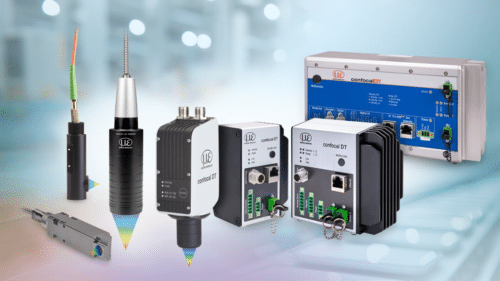
A confocal displacement sensor and a confocal distance sensor are the same type of instrument, used for different measurement tasks. Bestech supplies them as a sensor and a controller that together form a complete confocal chromatic measurement system. The sensors suit inline quality control in factory operations.
How Confocal Chromatic Measurement Works
The measurement starts with polychromatic light, which is the same kind of light that a standard incandescent light bulb produces. A multi-lens optical system focuses this white light towards the target. The lenses are arranged so that the white light disperses into the individual colours of the spectrum, and each colour comes into focus at a different distance from the sensor.
A factory calibration assigns a specific distance to each wavelength. Only the wavelength that is entirely focused on the target is used for the measurement. The light reflected from the target passes through a confocal aperture onto a spectrometer, which processes the spectral changes. The controller then outputs the measured distance.
Key Features of Confocal Sensors
The IFS series sensors are available in standard and miniature versions. They measure in axial and radial orientation, which means the light leaves the sensor either along its axis or at a right angle to it. The IFS2402, for example, measures axial or radial displacement inside narrow cavities or drill holes.
The sensors are passive. They contain no electronic components, so they do not radiate heat to their surroundings. This allows measurement in extreme conditions such as vacuum, explosive and hazardous environments. The sensors work with the confocalDT controllers, which have a resolution of 1 nm and interfaces for analog, RS422, Ethernet and EtherCAT output. The controllers are configured through a web interface.
Key Advantages of Confocal Measurement
A confocal measurement sensor works independently of the target surface. The sensors measure reliably on dark, diffuse, highly reflective, shiny, mirrored and transparent surfaces. The emitter and receiver sit on one axis, so the light path leaves no scope for a shadow to form during measurement.
The spot size is very small, at 7 to 25 microns, and the light spot stays constant over the entire measuring range. The controllers compensate for the reflectivity of the surface in real time. Measuring rates run from 100 Hz to 6.5 kHz on the IFC2421/2422, and up to 25 kHz on the IFC2461 and 70 kHz on the IFC2471HS.
Measuring Distance, Displacement and Position
A confocal distance sensor measures the gap between the sensor and a target, and a confocal displacement sensor tracks how that gap changes. Position follows from the same signal. The IFS series covers measuring ranges from 0.1 to 30 mm and resolutions from 10 nm to 250 nm, depending on the sensor.
The choice of sensor sets the measuring range and the working distance. The IFS2405 has a large stand-off distance and high sensitivity for general measurement applications, with a measuring range of 0.3 to 30 mm. The IFS2407 axial version suits fast-moving and dynamic objects. The IFS2402 and IFS2403 miniature sensors suit measurement in restricted space.
Thickness Measurement of Transparent Materials
Confocal sensors can also measure the thickness of transparent materials from one side. This means the sensor only needs access to one face of the material, such as a sheet of glass. The sensor sees reflections from the top and the bottom surfaces of the material, and the controller works out the thickness from them. The IFS2403 and IFS2404 enable one-sided thickness measurement on transparent materials, and the IFS2407 also measures thickness.
Many electronic devices, solar panels and flat screens consist of several layers of transparent material. A multi-peak measurement feature lets the system read the thickness of each layer, including the air gap between layers, and the sensors can evaluate up to five layers of transparent material. The optional multi-peak module on the IFC2421/2422 controller provides this feature, as does the multi-peak version of the IFC2471HS, and the IFC2461 measures multi-layered objects. A thickness calibration function adapts to the refractive index of the material, which is stored in the controller.
Measurement of Reflective and Diffuse Surfaces
A shiny or mirrored surface reflects most of the light in one direction, and a dark or diffuse surface returns very little. The IFC2421/2422 controllers have an active exposure regulation function in the CCD array, which rapidly compensates for fast changing or difficult surfaces. The IFS2406 is designed for reflective and transparent surfaces, and the IFC2471HS controller is used for fast distance measurement on highly reflective and shiny surfaces.
Small Spot Size and Difficult Geometries
The light spot is very small, so a confocal sensor can measure fine details such as surface roughness and the pins of integrated circuits on a printed circuit board. The IFS2406 offers a very small light spot for measurement on extremely small objects. The IFS2407 combines a small spot size with a large tilt angle, which suits tilted surfaces and roughness measurement, and the IFS2402 reaches inside cavities and drill holes.
The shadow-free axial light path and the miniature housings help where access is limited. In a clean room or vacuum environment, the passive design of the sensors avoids heat from the sensor reaching the measurement. The IFS2406 is suited to measurement under vacuum.
Confocal Sensor Products
IFS2402 and IFS2403 miniature sensors
The IFS2402 measures from 0.4 to 2.5 mm with a resolution of 16 to 100 nm, and it suits axial or radial displacement measurement inside narrow cavities or drill holes. The IFS2403 has a slightly larger external diameter of 8 mm, a measuring range of 0.4 to 10 mm and a resolution of 16 to 250 nm. It also enables one-sided thickness measurement on transparent materials, because of its larger digital aperture.
IFS2404 compact low-cost sensor
The IFS2404 is a compact, miniature, low-cost sensor for high-volume applications such as OEM. It measures 2 mm with a resolution of 40 nm, and it can measure the thickness of transparent materials from one side.
IFS2405 sensor with large stand-off distance
The IFS2405 has a large stand-off distance and high sensitivity for general measurement applications. Its measuring range is 0.3 to 30 mm and its resolution is 10 to 36 nm.
IFS2406 sensor for reflective and transparent surfaces
The IFS2406 measures on reflective and transparent surfaces, in a range of 2.5 to 10 mm with a resolution of 24 nm. It suits vacuum environments and has a very small light spot for extremely small objects.
IFS2407 sensor with small spot size and large tilt angle
The IFS2407 measures displacement, thickness and roughness over 0.1 to 0.3 mm, with a resolution of 10 nm. The axial version suits fast-moving and dynamic objects.
confocalDT controllers
The IFC2421/2422 controllers come as single-channel and dual-channel versions, with a measuring rate adjustable from 100 Hz to 6.5 kHz and a resolution of 1 nm. The IFC2461 reaches 25 kHz and the IFC2471HS reaches 70 kHz, both with a resolution of 1 nm. Each of these controllers works with all IFS sensor models.
Frequently Asked Questions
How does a confocal chromatic sensor measure distance?
A confocal chromatic sensor identifies distance from the colour of the light that is in focus on the target. Each colour is assigned a specific distance by factory calibration, so the sensor works out the distance from the colour it detects. This makes the measurement largely independent of the surface, so it works on dark, diffuse, reflective, mirrored and transparent targets. Tell us your target material and we can confirm which sensor suits it.
Can a confocal sensor measure the thickness of glass?
Yes. Confocal sensors can measure the thickness of transparent materials such as glass from one side, and the multi-peak feature can measure up to five layers. Tell us the material, the layer count and the thickness range, and we can recommend the sensor and controller.
Can a confocal sensor work in a vacuum or hazardous area?
The sensors are passive and contain no electronic components, so they do not radiate heat. This allows use in vacuum, explosive and hazardous environments, and the IFS2406 is suited to vacuum. Tell us the environment and we can confirm the right sensor.
Can a confocal system be configured for OEM volumes?
The IFS2404 sensor is designed for high-volume applications such as OEM, and the IFC2421/2422 controllers are described as suited to low-cost, high-volume applications. Tell us your volume, your target surface and your interface, and we can discuss which combination suits your product.
Tell us the target surface, the measuring range and the measuring rate, and we will help you select the sensor and controller. To start, have a chat with us about your application.
-
IFS2407-xHT/VAC – Confocal Chromatic Sensor for High Temperature and Vacuum Applications
View Product -

ConfocalDT IFC2421/2422 | Universal confocal measurement system
View Product -

ConfocalDT IFC2461 | High performance confocal controller up to 25kHz
View Product -

ConfocalDT IFC2471HS | High speed confocal controllers up to 70kHz
View Product -

IFS Series, Confocal Chromatic Sensor
View Product
Measuring the distance to a surface at the nanometre level gets harder when the target is shiny, dark, transparent or tilted, or when the sensor has to fit inside a narrow cavity. Our confocal sensors allow the research or process engineer to measure distance, displacement and position, and the thickness of transparent materials, on surfaces from diffuse to mirrored, from a sensor with a 0.1 to 0.3 mm measuring range to one that measures up to 30 mm.
Every instrument is selected on several testing and environmental parameters: the measuring range, the target surface and the measuring rate. To help you achieve these objectives, our in-house applications engineers can help you define the project scope and application, select the equipment, and assist with system integration and technical support.
What Are Confocal Sensors?
Confocal sensors are optical sensors that measure distance without touching the target. A confocal chromatic sensor uses white light and a lens system that focuses each colour of that light at a different distance. A confocal measurement sensor reads which colour is in focus on the target and so works out the distance to it.
A confocal displacement sensor and a confocal distance sensor are the same type of instrument, used for different measurement tasks. Bestech supplies them as a sensor and a controller that together form a complete confocal chromatic measurement system. The sensors suit inline quality control in factory operations.
How Confocal Chromatic Measurement Works
The measurement starts with polychromatic light, which is the same kind of light that a standard incandescent light bulb produces. A multi-lens optical system focuses this white light towards the target. The lenses are arranged so that the white light disperses into the individual colours of the spectrum, and each colour comes into focus at a different distance from the sensor.
A factory calibration assigns a specific distance to each wavelength. Only the wavelength that is entirely focused on the target is used for the measurement. The light reflected from the target passes through a confocal aperture onto a spectrometer, which processes the spectral changes. The controller then outputs the measured distance.
Key Features of Confocal Sensors
The IFS series sensors are available in standard and miniature versions. They measure in axial and radial orientation, which means the light leaves the sensor either along its axis or at a right angle to it. The IFS2402, for example, measures axial or radial displacement inside narrow cavities or drill holes.
The sensors are passive. They contain no electronic components, so they do not radiate heat to their surroundings. This allows measurement in extreme conditions such as vacuum, explosive and hazardous environments. The sensors work with the confocalDT controllers, which have a resolution of 1 nm and interfaces for analog, RS422, Ethernet and EtherCAT output. The controllers are configured through a web interface.
Key Advantages of Confocal Measurement
A confocal measurement sensor works independently of the target surface. The sensors measure reliably on dark, diffuse, highly reflective, shiny, mirrored and transparent surfaces. The emitter and receiver sit on one axis, so the light path leaves no scope for a shadow to form during measurement.
The spot size is very small, at 7 to 25 microns, and the light spot stays constant over the entire measuring range. The controllers compensate for the reflectivity of the surface in real time. Measuring rates run from 100 Hz to 6.5 kHz on the IFC2421/2422, and up to 25 kHz on the IFC2461 and 70 kHz on the IFC2471HS.
Measuring Distance, Displacement and Position
A confocal distance sensor measures the gap between the sensor and a target, and a confocal displacement sensor tracks how that gap changes. Position follows from the same signal. The IFS series covers measuring ranges from 0.1 to 30 mm and resolutions from 10 nm to 250 nm, depending on the sensor.
The choice of sensor sets the measuring range and the working distance. The IFS2405 has a large stand-off distance and high sensitivity for general measurement applications, with a measuring range of 0.3 to 30 mm. The IFS2407 axial version suits fast-moving and dynamic objects. The IFS2402 and IFS2403 miniature sensors suit measurement in restricted space.
Thickness Measurement of Transparent Materials
Confocal sensors can also measure the thickness of transparent materials from one side. This means the sensor only needs access to one face of the material, such as a sheet of glass. The sensor sees reflections from the top and the bottom surfaces of the material, and the controller works out the thickness from them. The IFS2403 and IFS2404 enable one-sided thickness measurement on transparent materials, and the IFS2407 also measures thickness.
Many electronic devices, solar panels and flat screens consist of several layers of transparent material. A multi-peak measurement feature lets the system read the thickness of each layer, including the air gap between layers, and the sensors can evaluate up to five layers of transparent material. The optional multi-peak module on the IFC2421/2422 controller provides this feature, as does the multi-peak version of the IFC2471HS, and the IFC2461 measures multi-layered objects. A thickness calibration function adapts to the refractive index of the material, which is stored in the controller.
Measurement of Reflective and Diffuse Surfaces
A shiny or mirrored surface reflects most of the light in one direction, and a dark or diffuse surface returns very little. The IFC2421/2422 controllers have an active exposure regulation function in the CCD array, which rapidly compensates for fast changing or difficult surfaces. The IFS2406 is designed for reflective and transparent surfaces, and the IFC2471HS controller is used for fast distance measurement on highly reflective and shiny surfaces.
Small Spot Size and Difficult Geometries
The light spot is very small, so a confocal sensor can measure fine details such as surface roughness and the pins of integrated circuits on a printed circuit board. The IFS2406 offers a very small light spot for measurement on extremely small objects. The IFS2407 combines a small spot size with a large tilt angle, which suits tilted surfaces and roughness measurement, and the IFS2402 reaches inside cavities and drill holes.
The shadow-free axial light path and the miniature housings help where access is limited. In a clean room or vacuum environment, the passive design of the sensors avoids heat from the sensor reaching the measurement. The IFS2406 is suited to measurement under vacuum.
Confocal Sensor Products
IFS2402 and IFS2403 miniature sensors
The IFS2402 measures from 0.4 to 2.5 mm with a resolution of 16 to 100 nm, and it suits axial or radial displacement measurement inside narrow cavities or drill holes. The IFS2403 has a slightly larger external diameter of 8 mm, a measuring range of 0.4 to 10 mm and a resolution of 16 to 250 nm. It also enables one-sided thickness measurement on transparent materials, because of its larger digital aperture.
IFS2404 compact low-cost sensor
The IFS2404 is a compact, miniature, low-cost sensor for high-volume applications such as OEM. It measures 2 mm with a resolution of 40 nm, and it can measure the thickness of transparent materials from one side.
IFS2405 sensor with large stand-off distance
The IFS2405 has a large stand-off distance and high sensitivity for general measurement applications. Its measuring range is 0.3 to 30 mm and its resolution is 10 to 36 nm.
IFS2406 sensor for reflective and transparent surfaces
The IFS2406 measures on reflective and transparent surfaces, in a range of 2.5 to 10 mm with a resolution of 24 nm. It suits vacuum environments and has a very small light spot for extremely small objects.
IFS2407 sensor with small spot size and large tilt angle
The IFS2407 measures displacement, thickness and roughness over 0.1 to 0.3 mm, with a resolution of 10 nm. The axial version suits fast-moving and dynamic objects.
confocalDT controllers
The IFC2421/2422 controllers come as single-channel and dual-channel versions, with a measuring rate adjustable from 100 Hz to 6.5 kHz and a resolution of 1 nm. The IFC2461 reaches 25 kHz and the IFC2471HS reaches 70 kHz, both with a resolution of 1 nm. Each of these controllers works with all IFS sensor models.
Frequently Asked Questions
How does a confocal chromatic sensor measure distance?
A confocal chromatic sensor identifies distance from the colour of the light that is in focus on the target. Each colour is assigned a specific distance by factory calibration, so the sensor works out the distance from the colour it detects. This makes the measurement largely independent of the surface, so it works on dark, diffuse, reflective, mirrored and transparent targets. Tell us your target material and we can confirm which sensor suits it.
Can a confocal sensor measure the thickness of glass?
Yes. Confocal sensors can measure the thickness of transparent materials such as glass from one side, and the multi-peak feature can measure up to five layers. Tell us the material, the layer count and the thickness range, and we can recommend the sensor and controller.
Can a confocal sensor work in a vacuum or hazardous area?
The sensors are passive and contain no electronic components, so they do not radiate heat. This allows use in vacuum, explosive and hazardous environments, and the IFS2406 is suited to vacuum. Tell us the environment and we can confirm the right sensor.
Can a confocal system be configured for OEM volumes?
The IFS2404 sensor is designed for high-volume applications such as OEM, and the IFC2421/2422 controllers are described as suited to low-cost, high-volume applications. Tell us your volume, your target surface and your interface, and we can discuss which combination suits your product.
Tell us the target surface, the measuring range and the measuring rate, and we will help you select the sensor and controller. To start, have a chat with us about your application.
