

The DEMEC demountable mechanical strain gauge is a proven and highly accurate instrument used for precise strain measurement in laboratory and field environments. Known for its reliability and cost-effective performance, the DEMEC strain gauge is widely used for structural monitoring, materials testing, and long-term crack monitoring applications.
Accurate strain measurements of up to ±5 × 10⁻⁶ strain can be achieved under controlled laboratory conditions when the instrument is correctly manufactured, calibrated, and used. Optimal accuracy is obtained when the gauge is positioned horizontally and readings are taken within the central operating range of the dial.
The DEMEC gauge uses a lever and dial (or digital indicator) arrangement mounted on an Invar main beam to minimise errors caused by thermal expansion. Careful mounting of the reference and locating discs is essential, particularly when measuring concrete structures subjected to temperature variation. In such cases, a concrete dummy bar may be used to compensate for temperature-related strain effects.
The DEMEC strain gauge features two locating points, one fixed and one movable, allowing strain to be measured accurately over the defined gauge length. Each DEMEC gauge is supplied complete with reference and setting bars, along with a pack of 100 standard locating discs.
Designed as a single-instrument solution, the DEMEC system enables repeatable strain measurements at multiple locations across a structure. Standard gauge lengths range from 100 mm to 500 mm, with custom lengths up to 2000 mm available on request. This makes the DEMEC system ideal for demec gauge crack monitoring, structural assessment, and long-term deformation studies.
Digital DEMEC strain gauges incorporate a high-resolution digital indicator (0.001 mm), zero-set functionality, and SPC output capability. The indicator can be connected to a data processor for recording and analysis, with spindle movement measured digitally via a linear encoder. The system offers fast response speeds of up to 1000 mm/sec and is battery operated.
For detailed specifications, please download the product brochure or contact Bestech Australia.
Accurate strain measurements of up to ±5 × 10⁻⁶ strain can be achieved under controlled laboratory conditions when the instrument is correctly manufactured, calibrated, and used. Optimal accuracy is obtained when the gauge is positioned horizontally and readings are taken within the central operating range of the dial.
The DEMEC gauge uses a lever and dial (or digital indicator) arrangement mounted on an Invar main beam to minimise errors caused by thermal expansion. Careful mounting of the reference and locating discs is essential, particularly when measuring concrete structures subjected to temperature variation. In such cases, a concrete dummy bar may be used to compensate for temperature-related strain effects.
The DEMEC strain gauge features two locating points, one fixed and one movable, allowing strain to be measured accurately over the defined gauge length. Each DEMEC gauge is supplied complete with reference and setting bars, along with a pack of 100 standard locating discs.
Designed as a single-instrument solution, the DEMEC system enables repeatable strain measurements at multiple locations across a structure. Standard gauge lengths range from 100 mm to 500 mm, with custom lengths up to 2000 mm available on request. This makes the DEMEC system ideal for demec gauge crack monitoring, structural assessment, and long-term deformation studies.
Digital DEMEC strain gauges incorporate a high-resolution digital indicator (0.001 mm), zero-set functionality, and SPC output capability. The indicator can be connected to a data processor for recording and analysis, with spindle movement measured digitally via a linear encoder. The system offers fast response speeds of up to 1000 mm/sec and is battery operated.
For detailed specifications, please download the product brochure or contact Bestech Australia.
Micro-strains represented by one division on the dial gauge, or one increment on the digital indicator:

 In mechanical strain measurement, two rigid or semi-rigid points on an elastic body may exhibit up to six degrees of freedom relative to one another. Any instrument designed to measure strain between these points must allow for these movements to avoid introducing internal stresses or measurement errors.
The DEMEC demountable mechanical strain gauge achieves this through two virtual point connections between the instrument and the test specimen. Translational freedom is provided by a movable arm pivoting about a knife-edge seating. The practical connection is achieved using a hardened conical locating point seated into a cylindrical locating disc.
Microscopic examination shows that initial loading of the hardened cone causes local plastic deformation of the steel locating disc, forming an approximately toroidal seating surface. This cone-and-toroid interface provides a fixed centre of rotation about the x- and y-axes, as well as the z-axis, allowing accurate strain measurement over a wide range of angular movement.
The cone apex angle of 60 degrees and the 6.3 mm stainless steel locating discs (with 1 mm blind holes) ensure repeatable positioning. For typical concrete strain measurements, the angular rotation of the moving arm is very small, making cosine-related reading errors negligible.
A key design consideration of the DEMEC gauge is ensuring that the locating force applied by the operator is directed along the instrument’s measurement axis. While a subsidiary alignment frame can be used, practical experience shows that correct hand positioning prevents deformation caused by lateral thrust or vertical variation.
The digital version of the DEMEC strain gauge utilises a Mitutoyo 543 digital indicator for enhanced resolution and repeatability.
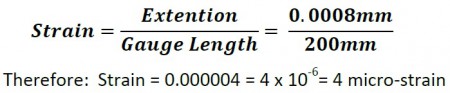
Strain Measurement Formula

Example 1 Gauge length: 200 mm Dial reading change: 0.001 mm Extension = 0.8 (nominal pivot lever ratio) × 1 × 0.001 mm Extension = 0.0008 mm Strain = 0.0008 / 200 Strain = 4 × 10⁻⁶ (4 microstrain)
Example 2 Gauge length: 200 mm Dial reading change: 0.5 mm Extension = 0.8 × 500 × 0.001 mm Extension = 0.4 mm Strain = 0.4 / 200 Strain = 0.002 (2000 microstrain)


