
A machine, a test rig or an industrial product has a part that moves, and the engineer has to know how far it has moved. That could be the stroke of a hydraulic cylinder, the travel of a spring or the insertion distance on an assembly. A potentiometer displacement sensor gives that answer as an electrical signal that a controller or data acquisition system can read. Our potentiometer displacement sensors allow the test or design engineer to measure linear travel directly on the moving part, from a miniature sensor with a 12.7 mm housing diameter and a 25 mm range to a rodless sensor that measures up to 2000 mm.
Every instrument is selected on several testing and environmental parameters: the measuring range, the mounting arrangement and the operating environment. To help you achieve these objectives, our in-house applications engineers can help you define the project scope and application, select the equipment, and assist with system integration and technical support.
What Is a Potentiometer Displacement Sensor?
A potentiometer displacement sensor is a position sensor that converts the movement of an object into an electrical signal. It contains a resistance track and a slider. The slider is coupled to the moving part, so the sensor measures displacement directly on that part.
Potentiometric displacement sensors are also called linear potentiometers or potentiometer position sensors. All of these names describe the same measuring principle. Potentiometer displacement measurement is used for industrial displacement measurement on machines, test rigs and equipment.
How Potentiometric Displacement Sensors Work
The slider moves along the resistance track when the moving part moves. The position of the slider on the track sets the output signal of the sensor. A controller or data acquisition system reads that signal and converts it to a displacement value in millimetres.
On the sensors on this page, the resistance track is made of conductive plastic material. This gives low friction, high abrasion resistance and long-term measurement stability. The 8709 has a special multi-finger slider, which helps keep good contact with the measuring object.
Linear and Angular Displacement Measurement
A linear potentiometer displacement sensor measures movement along a straight line. The slider moves along a straight track, and the measuring range is the length of that track. The sensors on this page are linear, with measuring ranges from 0 to 25 mm up to 0 to 2000 mm depending on the model.
An angular version measures rotation instead. The slider turns around a circular track, and the output signal gives the angle of the shaft in degrees. The measuring range of an angular sensor is stated in degrees, so it is one of the first things to check. If you need to measure an angle, tell us the range and the shaft arrangement, and we can confirm what suits your application. Linear measurement covers stroke length, insertion distance, spring travel and the position of a plunger or platform.
Key Features of Potentiometer Displacement Sensors
The 8719 is a linear potentiometer displacement sensor with a measuring resolution of 0.01 mm and a non-linearity of 0.05% of full scale. It has a durability of up to 100 million movements. The 8709, 8718 and 8719 are all adjustable at speeds up to 10 m/s, so the sensor can follow fast movements.
Mounting features vary by model. The 8709 attaches easily and has optional flange and ball joint adapters. The 8719 has a ball joint coupling attached at the end of the sliding rod to minimise axial measurement errors. The 8718 is a rodless sensor with high resolution and a large measuring range of up to 2 m.
For harsh conditions, the 8719 can be supplied with an optional IP67 protection standard for underwater applications. The 8718 is also protected against electrical interference.
Key Advantages
A potentiometer displacement sensor measures displacement directly on the moving part and gives an electrical signal that a controller or data acquisition system can read. The same measuring principle covers short strokes and ranges up to 2000 mm.
The individual models add their own benefits. The 8709 has a 12.7 mm housing diameter for compact structures. The rodless 8718 measures up to 2000 mm. The 8719 has 0.01 mm resolution, 0.05% of full scale non-linearity and a durability of up to 100 million movements. The conductive plastic track gives low friction and high abrasion resistance.
Applications of Potentiometer Displacement Sensors
In industrial applications, potentiometer displacement measurement tracks the stroke on riveting machines, the length on pipe bending machines and the movement of hoisting platforms. Potentiometer position sensors also measure the displacement of plungers, knee levers and extruders, and the length of hydraulic and pneumatic cylinders. On vehicles, they measure the stroke length on a chassis and the spring travel on axes.
In testing and inspection, they detect positions on coordinate inspection machines, measure insertion distances and offsets on bearings, and measure bending and deformation. The 8719 is also used for displacement measurement in an electromagnetic environment and in longitudinal press-fit operations.
If you are designing a sensor into your own machine, the same models can serve as the position feedback in your product. Tell us the travel, the speed and the environment, and we will talk through the options.
Potentiometer Sensor Products
8709 miniature potentiometric displacement sensor
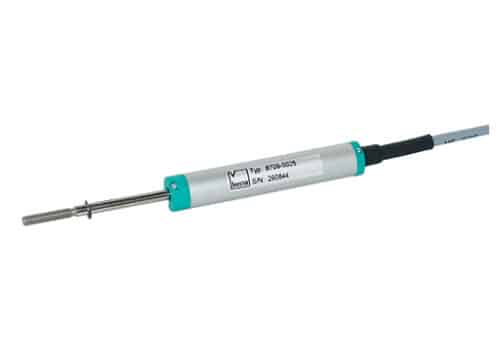
The 8709 has a housing diameter of only 12.7 mm, which suits miniature, compact and small structures. It measures from 0 to 25 mm and from 0 to 250 mm, at speeds up to 10 m/s. Optional flange and ball joint adapters allow it to fit a wide range of measurement applications.
8718 rodless potentiometric displacement sensor
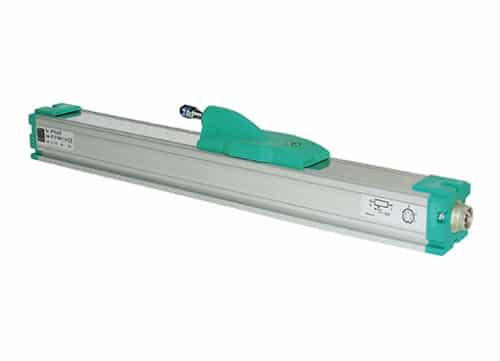
The 8718 is a high-resolution rodless sensor with measuring ranges from 0 to 100 mm and from 0 to 2000 mm. The conductive plastic resistance track gives low friction, high abrasion resistance and long-term measurement stability. It suits hydraulic and pneumatic cylinders, coordinate inspection machines and plunger or extruder displacement.
8719 high speed linear potentiometer
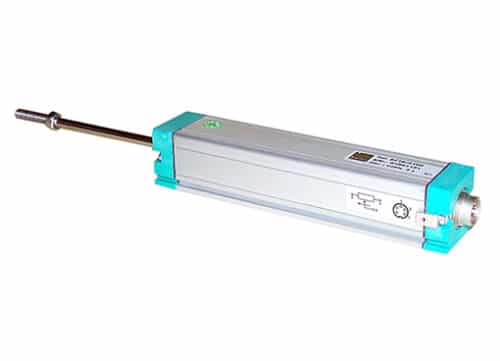
The 8719 measures from 0 to 50 mm and from 0 to 900 mm, with a non-linearity of 0.05% of full scale and a resolution of 0.01 mm. It has a plug or cable connection and a durability of up to 100 million movements. An optional IP67 version suits underwater applications.
How to Select a Potentiometer Displacement Sensor
Start with the stroke. Measure the full travel of the moving part and choose a sensor whose measuring range covers it. Then consider how the sensor mounts. A compact structure points to the 8709, a very long stroke to the rodless 8718, and a fast movement with a ball joint coupling to the 8719.
Next, think about speed and duty. How fast does the part move, and how many movements will the sensor make over its life? The 8719 has a durability of up to 100 million movements, and we can confirm the duty for the other models. Also consider the environment: wet or underwater use calls for the 8719 with the IP67 option, and an electromagnetic environment is a stated application of the 8719.
Finally, think about the system. The sensor signal goes to a controller or data acquisition system. We can talk through channel count, signal type and software before you choose, so the sensor and the system suit each other.
Frequently Asked Questions
What measuring range can a potentiometer displacement sensor cover?
Across the models on this page, the measuring range runs from 0 to 25 mm up to 0 to 2000 mm. The 8709 covers 0 to 25 mm and 0 to 250 mm, the 8719 covers 0 to 50 mm and 0 to 900 mm, and the rodless 8718 covers 0 to 100 mm and 0 to 2000 mm.
Can a potentiometer position sensor follow fast movement?
The 8709, 8718 and 8719 are adjustable at speeds up to 10 m/s. Tell us the speed and the travel of your application, and we can confirm which model suits it.
Can a potentiometer displacement sensor work underwater?
The 8719 can be supplied with an optional IP67 protection standard for underwater applications. Tell us the depth and the duration, and we can confirm whether that option suits your application.
How do I connect the sensor to a data acquisition system?
The sensor signal goes to a controller or data acquisition system. Tell us your channel count and signal requirements, and we can help match the system to the sensor.
Tell us the travel, the speed and the environment, and we will help you select the sensor. To start, have a chat with us about your application.
A machine, a test rig or an industrial product has a part that moves, and the engineer has to know how far it has moved. That could be the stroke of a hydraulic cylinder, the travel of a spring or the insertion distance on an assembly. A potentiometer displacement sensor gives that answer as an electrical signal that a controller or data acquisition system can read. Our potentiometer displacement sensors allow the test or design engineer to measure linear travel directly on the moving part, from a miniature sensor with a 12.7 mm housing diameter and a 25 mm range to a rodless sensor that measures up to 2000 mm.
Every instrument is selected on several testing and environmental parameters: the measuring range, the mounting arrangement and the operating environment. To help you achieve these objectives, our in-house applications engineers can help you define the project scope and application, select the equipment, and assist with system integration and technical support.
What Is a Potentiometer Displacement Sensor?
A potentiometer displacement sensor is a position sensor that converts the movement of an object into an electrical signal. It contains a resistance track and a slider. The slider is coupled to the moving part, so the sensor measures displacement directly on that part.
Potentiometric displacement sensors are also called linear potentiometers or potentiometer position sensors. All of these names describe the same measuring principle. Potentiometer displacement measurement is used for industrial displacement measurement on machines, test rigs and equipment.
How Potentiometric Displacement Sensors Work
The slider moves along the resistance track when the moving part moves. The position of the slider on the track sets the output signal of the sensor. A controller or data acquisition system reads that signal and converts it to a displacement value in millimetres.
On the sensors on this page, the resistance track is made of conductive plastic material. This gives low friction, high abrasion resistance and long-term measurement stability. The 8709 has a special multi-finger slider, which helps keep good contact with the measuring object.
Linear and Angular Displacement Measurement
A linear potentiometer displacement sensor measures movement along a straight line. The slider moves along a straight track, and the measuring range is the length of that track. The sensors on this page are linear, with measuring ranges from 0 to 25 mm up to 0 to 2000 mm depending on the model.
An angular version measures rotation instead. The slider turns around a circular track, and the output signal gives the angle of the shaft in degrees. The measuring range of an angular sensor is stated in degrees, so it is one of the first things to check. If you need to measure an angle, tell us the range and the shaft arrangement, and we can confirm what suits your application. Linear measurement covers stroke length, insertion distance, spring travel and the position of a plunger or platform.
Key Features of Potentiometer Displacement Sensors
The 8719 is a linear potentiometer displacement sensor with a measuring resolution of 0.01 mm and a non-linearity of 0.05% of full scale. It has a durability of up to 100 million movements. The 8709, 8718 and 8719 are all adjustable at speeds up to 10 m/s, so the sensor can follow fast movements.
Mounting features vary by model. The 8709 attaches easily and has optional flange and ball joint adapters. The 8719 has a ball joint coupling attached at the end of the sliding rod to minimise axial measurement errors. The 8718 is a rodless sensor with high resolution and a large measuring range of up to 2 m.
For harsh conditions, the 8719 can be supplied with an optional IP67 protection standard for underwater applications. The 8718 is also protected against electrical interference.
Key Advantages
A potentiometer displacement sensor measures displacement directly on the moving part and gives an electrical signal that a controller or data acquisition system can read. The same measuring principle covers short strokes and ranges up to 2000 mm.
The individual models add their own benefits. The 8709 has a 12.7 mm housing diameter for compact structures. The rodless 8718 measures up to 2000 mm. The 8719 has 0.01 mm resolution, 0.05% of full scale non-linearity and a durability of up to 100 million movements. The conductive plastic track gives low friction and high abrasion resistance.
Applications of Potentiometer Displacement Sensors
In industrial applications, potentiometer displacement measurement tracks the stroke on riveting machines, the length on pipe bending machines and the movement of hoisting platforms. Potentiometer position sensors also measure the displacement of plungers, knee levers and extruders, and the length of hydraulic and pneumatic cylinders. On vehicles, they measure the stroke length on a chassis and the spring travel on axes.
In testing and inspection, they detect positions on coordinate inspection machines, measure insertion distances and offsets on bearings, and measure bending and deformation. The 8719 is also used for displacement measurement in an electromagnetic environment and in longitudinal press-fit operations.
If you are designing a sensor into your own machine, the same models can serve as the position feedback in your product. Tell us the travel, the speed and the environment, and we will talk through the options.
Potentiometer Sensor Products
8709 miniature potentiometric displacement sensor
The 8709 has a housing diameter of only 12.7 mm, which suits miniature, compact and small structures. It measures from 0 to 25 mm and from 0 to 250 mm, at speeds up to 10 m/s. Optional flange and ball joint adapters allow it to fit a wide range of measurement applications.
8718 rodless potentiometric displacement sensor
The 8718 is a high-resolution rodless sensor with measuring ranges from 0 to 100 mm and from 0 to 2000 mm. The conductive plastic resistance track gives low friction, high abrasion resistance and long-term measurement stability. It suits hydraulic and pneumatic cylinders, coordinate inspection machines and plunger or extruder displacement.
8719 high speed linear potentiometer
The 8719 measures from 0 to 50 mm and from 0 to 900 mm, with a non-linearity of 0.05% of full scale and a resolution of 0.01 mm. It has a plug or cable connection and a durability of up to 100 million movements. An optional IP67 version suits underwater applications.
How to Select a Potentiometer Displacement Sensor
Start with the stroke. Measure the full travel of the moving part and choose a sensor whose measuring range covers it. Then consider how the sensor mounts. A compact structure points to the 8709, a very long stroke to the rodless 8718, and a fast movement with a ball joint coupling to the 8719.
Next, think about speed and duty. How fast does the part move, and how many movements will the sensor make over its life? The 8719 has a durability of up to 100 million movements, and we can confirm the duty for the other models. Also consider the environment: wet or underwater use calls for the 8719 with the IP67 option, and an electromagnetic environment is a stated application of the 8719.
Finally, think about the system. The sensor signal goes to a controller or data acquisition system. We can talk through channel count, signal type and software before you choose, so the sensor and the system suit each other.
Frequently Asked Questions
What measuring range can a potentiometer displacement sensor cover?
Across the models on this page, the measuring range runs from 0 to 25 mm up to 0 to 2000 mm. The 8709 covers 0 to 25 mm and 0 to 250 mm, the 8719 covers 0 to 50 mm and 0 to 900 mm, and the rodless 8718 covers 0 to 100 mm and 0 to 2000 mm.
Can a potentiometer position sensor follow fast movement?
The 8709, 8718 and 8719 are adjustable at speeds up to 10 m/s. Tell us the speed and the travel of your application, and we can confirm which model suits it.
Can a potentiometer displacement sensor work underwater?
The 8719 can be supplied with an optional IP67 protection standard for underwater applications. Tell us the depth and the duration, and we can confirm whether that option suits your application.
How do I connect the sensor to a data acquisition system?
The sensor signal goes to a controller or data acquisition system. Tell us your channel count and signal requirements, and we can help match the system to the sensor.
Tell us the travel, the speed and the environment, and we will help you select the sensor. To start, have a chat with us about your application.
