710B at a glance
- Up to 45 switchable faults across five categories
- Integrated 10-inch touch screen, with no laptop or software needed
- Remote fault control from a web browser over WiFi or Ethernet
- One PC can run several panels at the same time
- Active faults restored after a power interruption
- Panel design follows AS/NZS 3000:2018
- Alternative energy input for multiple-source isolation testing
- Bench mounting or full-height stand, with wall brackets available
Built for UEEEL0039 capstone training and assessment
UEEEL0039 is the electrotechnology unit titled Design, install and verify compliance and functionality of general electrical installations. It is the capstone unit for the Certificate III in Electrotechnology, and it supersedes UEENEEG105A. The 710B electrical test panel supports practical UEEEL0039 assessment and suits courses under the current or the previous training package. Apprentices use the panel from first year through to licence assessment, and industry can use it for contractor training and staff upskilling. As a capstone assessment board and electrotechnology training equipment, it lets every student find faults in the same installation without rewiring a circuit.What the panel simulates
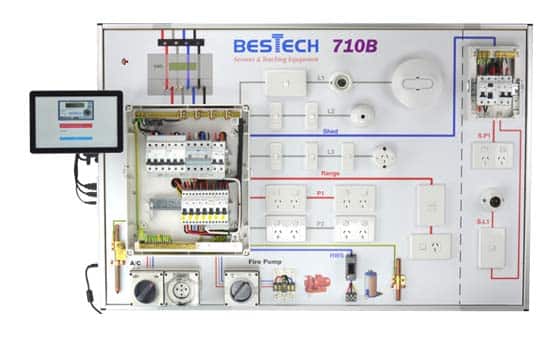
The electrical test panel represents a low voltage domestic installation. The table lists each circuit and what a student tests or verifies on it.| Circuit | What the student tests or verifies |
|---|---|
| Main switchboard | Incoming supply, protection and isolation |
| Sub-main distribution board | Protection and connection of the sub circuits |
| Three-phase air conditioning circuit | Three-phase connections, protection and earthing |
| Three power circuits (five GPOs) | Polarity, earth continuity and insulation at outlets |
| Four lighting circuits (two-way and three-way) | Switching arrangements and circuit connections |
| Smoke detector | Connection and operation of the detector circuit |
| Hot water circuit with isolation switch | Isolation and protection of a heating load |
| Range circuit | Protection and connection of a high current appliance |
| Three-phase safety system circuit | Three-phase verification of a safety circuit |
| Earth electrode | Earth connection and its continuity |
| Equipotential bond | Continuity of bonding conductors |
| Alternative energy input | Isolation of a second energy source |
| Independent earth terminal | Earthing of the alternative supply |
Fault categories explained
The electrical test panel groups its 45 faults into five categories. Each category matches a verification test, and that test is how a student finds the fault, which makes the panel useful for electrical fault finding training as well as assessment.Open circuit, short circuit and interconnection faults
An open circuit breaks the current path, a short circuit joins conductors that should stay apart, and an interconnection fault links two circuits. Continuity and circuit separation checks find them, as a student works along the circuit until the break or the extra connection shows up. Left undetected, they leave circuits dead or energised through the wrong path.
Polarity faults
Active and neutral are reversed at an outlet, a switch or the supply. A polarity test finds the reversal, as students check active and neutral at each outlet and switch. It matters for safety because reversed polarity can leave equipment live when its switch is off.
Fault loop impedance faults
The impedance of the fault path is too high for the protective device to operate in time. A fault loop impedance test finds it, as students compare the measured value with the limit for the protective device. If the device does not trip quickly, exposed metal can stay live during a fault.
Earthing faults
Earth connections or bonding are missing or poor. An earth continuity test finds them, as students measure the earth path from the switchboard to each exposed metal part. Without a low resistance earth path, fault current cannot flow, and the protective device may never operate.
Insulation resistance faults
Insulation between conductors, or between a conductor and earth, is too low. An insulation resistance test finds it, as students test between conductors and between conductors and earth. Weak insulation lets current leak, and it can cause shock or fire.
Instructor control and custom fault sequences
The 710B works as a fault insertion panel from its own touch screen, without a PC or software. Over WiFi or Ethernet, the embedded web server adds browser control on all major browsers, and Panel View shows active faults on the panel or across the network. Each panel stores up to ten fault sequences, which an instructor recalls with one touch so every student gets a different scenario. After a power interruption, the panel re-applies the active faults at the next login.Testing isolation with solar and other alternative supplies
On the 710B electrical test panel, an alternative energy input, its switchgear and an independent earth terminal let students practise isolation on a system with more than one energy source, such as solar. The skill matters because an installation with solar or battery supplies must be isolated from every source before work starts.Technical specifications
| Specification | Value |
|---|---|
| Dimensions (W x H x D) | 1208 mm x 808 mm x 80 mm |
| Weight | 37 kg without stand |
| Mounting | Bench mount or full-height stand; wall brackets available |
| Control | 10-inch touch screen, or web browser |
| Connectivity | WiFi or Ethernet (optional) |
| Faults | Up to 45 in five categories |
| Fault sequences | Up to ten stored on each panel |
| Standard | AS/NZS 3000:2018 |
Buying checklist for TAFEs and RTOs
Tender panels for an electrical installation training and assessment board commonly ask for the points below. The 710B electrical test panel meets the first three, and Bestech Australia confirms the rest in the quote.- Commercially available product: the 710B is a standard Bestech product, not a one-off build.
- AS/NZS 3000:2018: the panel is an AS/NZS 3000 training panel built to the current edition.
- Training package fit: the panel supports UEEEL0039 and the previous unit it supersedes.
- Delivery and installation: Bestech Australia supplies the panel with on-site training and commissioning support available.
- Instructor training: state the sessions needed, and the quote covers them.
- Support period: state the period your tender requires, and the quote sets it out.
Designed and made in Australia
Bestech Australia designs and manufactures the 710B electrical test panel at its Dingley, Victoria facility, as an upgrade of the earlier 710A. Local manufacture can count in public tenders, and it keeps questions on service and support with the team that builds the panel.Frequently asked questions
What is UEEEL0039?
UEEEL0039 is the capstone electrotechnology unit, Design, install and verify compliance and functionality of general electrical installations. It supersedes UEENEEG105A. The 710B supports its practical assessment by giving every student a panel with faults to find, test and verify, so the instructor can judge each student on the same installation.
How many faults can the 710B simulate?
The 710B electrical test panel simulates up to 45 faults across five categories: open circuit, short circuit and interconnection, polarity, fault loop impedance, earthing, and insulation resistance. The five categories match the verification tests students must perform. Instructors group faults into sequences, so each student can receive a different scenario.
Do instructors need a PC to insert faults?
No. The integrated 10-inch touch screen applies faults without a PC, laptop or external software. A network connection is optional, and it adds fault control from a web browser. Panel View shows the active faults on the panel itself, so the instructor can check what each student faces without leaving the room.
Can one instructor control several panels?
Yes. One PC can operate several 710B electrical test panels at the same time through the embedded web server of each panel, once the panels connect to the network by WiFi or Ethernet. Each panel stores its own fault sequences, so the instructor can assign a stored sequence to each student.
What happens to active faults after a power outage?
The panel remembers which faults are active. After a power interruption, the instructor logs in again and the panel re-applies those faults, so an assessment can continue without starting over. Students keep working on the same scenario, which keeps the assessment fair.
Can the panel be used for industry training?
Yes. Besides TAFE and RTO courses, industry can use the 710B electrical test panel for training on-site contractors and upskilling staff. The same faults and verification tests apply, so contractors practise current installation and verification practice on a safe, low voltage panel.
Talk to the Bestech Australia teaching team
Request a demonstration, or download the 710B datasheet. Call (03) 9540 5100 to discuss your electrical test panel and training needs.
Key Features
- Fault capability: 45 switchable faults in five categories (open circuit, short circuit and interconnections; polarity; fault loop impedance; earthing; insulation resistance)
- Control: 10-inch touch screen, local or remote fault activation via embedded web server, multiple panels from one PC
- Standards and competency: AS/NZS 3000:2018; assessment of UEEEL0039
- Energy sources: alternative energy input, solar input switchgear and independent earth for multiple-source isolation testing
- Dimensions and weight: 1208 mm (W) x 808 mm (H) x 80 mm (D); 37 kg without stand