
The problem
Lithium brine well monitoring at Salar de Atacama starts with groundwater pumped up from wells. The salt pan is a sensitive ecosystem, and pumping out too much groundwater would cause irreparable environmental damage.
Salar de Atacama is a salt pan at the foot of the Andes in the Atacama Desert. It formed as a primeval lake evaporated, and it holds lithium along with borax and potassium salt. Groundwater carrying the dissolved salts is pumped up and guided into flat basins, where potassium chloride and potassium sulphate precipitate while lithium and boron stay in the solution. The brine then travels by pipeline for further processing. A mining company working there has to monitor how the aquifer recovers after extraction, as Chilean authorities require.
That means measuring how the groundwater level varies and comparing it with the volume of water pumped out. It also means knowing what is in the water, because conductivity is directly related to the water’s salinity, and salinity allows conclusions about mineral content such as lithium.
The site makes this hard on equipment. The brine water can damage even stainless steel over time, and temperatures alternate rapidly between high daytime heat and nighttime frost. Whatever is left in the well has to cope with both.
The approach
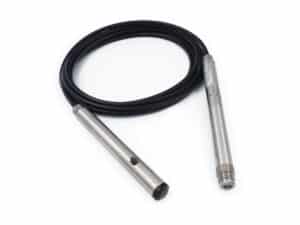
Recording level, temperature and conductivity in a remote well starts with a logger that looks after itself. The CTD version of the DCX-22-AA-CTD series is an autonomous, battery-operated data logger that needs little maintenance. Along with water level, measured as pressure, and temperature, it records conductivity over long periods.
Turning pressure into an exact water level means removing the effect of air pressure. The loggers use the AA (absolute-absolute) method: a separate barometer measures the change in air pressure, and that value is subtracted from the hydrostatic pressure.
The AA method was chosen because of the strong temperature fluctuations. A relative pressure measurement channels air pressure up to the measuring cell through a reference tube, and with frost at night and heat by day, condensation would form in that tube and could clog the capillary tubes, giving incorrect results.
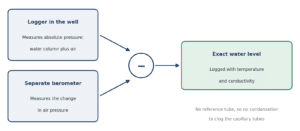
Figure 1. How the AA method finds the water level: the barometer’s air pressure is subtracted from the logger’s pressure reading. Schematic.
Because the brine water can damage even stainless steel, the manufacturer recommended special corrosion-resistant titanium sensors for the project.
Products used
The loggers are DCX-22AA-CTD data loggers. Their long-life battery keeps them recording for years, and the supplied software configures the logger, shows the data as graphs, corrects it with air pressure values, converts it to fill levels or other units and exports it. For digital pressure logging in the field, the LEO Ultimate digital pressure gauge has a built-in data logger and sends its readings to a PC over USB-C or to a phone or tablet over Bluetooth.
Outcomes
- Lithium brine well monitoring compares groundwater level variation with the volume extracted, which tracks aquifer recovery as Chilean authorities require.
- Conductivity is recorded alongside level and temperature, which points to salinity and to mineral content such as lithium.
- The AA method removes the reference tube, so there is no tube for condensation to form in and clog.
- Titanium sensors cope with water that can damage even stainless steel over time.
- The loggers run on batteries, need little maintenance and record over long periods.
The same situation can arise in Australia. The salt lakes of remote Western Australia hold hypersaline groundwater that is pumped to ponds so the salts concentrate.
