
A product that works on the bench can still fail after months of vibration and shock in transport or service. To find that failure before the customer does, a test engineer has to reproduce the vibration in the laboratory at a known level and frequency, and keep it there while the specimen responds. A vibration test system does this with an electrodynamic shaker, also called a vibration exciter, driven by a power amplifier and a vibration control system.
Our vibration test systems allow the test engineer to apply controlled vibration and shock to a product or structure, from portable permanent-magnet shakers with a nominal force of 9 N to water-cooled shakers rated at 300 kN that carry payloads of up to 2500 kg.
Every system is sized for the specimen, test levels and frequency range your laboratory works with, and our applications engineers support you locally from selection through to commissioning on site.
Vibration test systems
We offer a wide range of vibration test systems commonly found in product test and research laboratories, which can be used for mechanical stress testing, shock testing and the excitation of structures for modal analysis.
Standard vibration test systems
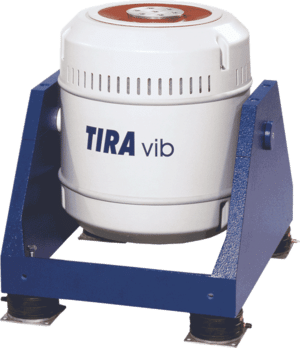
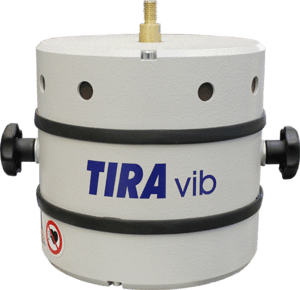
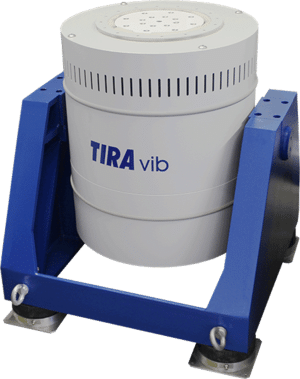
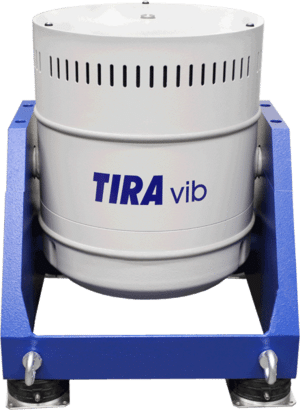
Standard systems cover nominal forces from 9 N to 300 kN. The smallest shakers use permanent magnets and a light-weight design for mobile use, while systems from 4 kN to 15 kN sit in a pivoting trunnion with clamping tables of 180 mm, 230 mm or 340 mm diameter. From 74 kN upwards, the shakers are water-cooled and hydrostatically guided.
Modal vibration test systems
Modal exciters from 100 N to 15 kN apply a controlled force to a structure for modal analysis. The smaller units are light and rugged for mobile use. On the 4 kN to 15 kN units, electronic zero-point regulation allows precise coupling to the structure and adjustment of axial stiffness.
Longstroke vibration test systems
Longstroke shakers rated at 4 kN, 8 kN and 15 kN offer 100 mm peak-to-peak displacement over a frequency range of 1 Hz to 2000 Hz. Their high cross-axial stiffness and adjustable zero-point regulation make them particularly suited to shock tests.
Inertial vibration test systems
Inertial exciters from 125 N to 650 N apply dynamic forces to large structures that cannot be placed on a shaker table. They are excited by permanent magnets, guided by a spring system and can be coupled at any angle through 360 degrees.
Comparing shaker types
All four types work on the same principle as a loudspeaker: current through a moving coil in a magnetic field produces a force proportional to that current, so the vibration level is set by the drive current. They differ in what the force acts on and how far the moving element can travel.
A standard shaker carries the specimen on its armature. The acceleration it can reach depends on the drive current and the total mass being moved, so the nominal force has to suit the specimen and fixture. At low frequencies, a standard shaker reaches its displacement and velocity limits before its acceleration limit.
A longstroke shaker addresses that limit with 100 mm of travel, which is why it suits shock tests and low-frequency work. A modal exciter applies a controlled force to a structure for modal analysis rather than carrying a specimen. An inertial exciter couples directly to a large structure at any angle and applies dynamic forces to it.
Choosing a vibration test system for your application
Start with the specimen and the test specification. The mass of the specimen and fixture, together with the acceleration the test requires, sets the force rating. The lowest test frequency and any shock pulses decide whether the displacement of a standard shaker is enough or whether a longstroke system is needed. If the structure is too large for any shaker table, an inertial exciter coupled to the structure may be the better choice.
Then consider how the specimen is mounted. Horizontal tests in the mounting position use an oil-film or hydrostatically guided slip table, and large specimens may need a head expander or a customised fixture. For combined vibration and climatic tests, chamber leadthroughs connect the shaker to a climatic chamber. We can confirm lead times for the complete system, including amplifier and cooling, with the quotation.
Local support for your vibration test system
Our applications engineers help you size the shaker, amplifier and cooling for your specimen and test levels before you order. When the system arrives, we install and commission it on site and remain your local contact for technical questions while it is in service.
Frequently asked questions
How do we work out the force rating we need?
The force depends on the total mass being moved, which includes the armature, the fixture and the specimen, and on the highest acceleration in the test. Send us the specimen mass and the test specification, and we will size the shaker and amplifier for it.
Can the system test in the horizontal direction?
Yes. Slip tables are available for horizontal tests in the mounting position, either oil-film guided or hydrostatically guided. Several standard and modal shakers also sit in a pivoting trunnion.
Can we combine vibration with climatic testing?
Yes. Climatic chamber leadthroughs connect the shaker to a climatic chamber for combined vibration and climatic testing. Tell us which chamber you use, and we will check the interface.
How do we excite a structure that will not fit on a shaker?
Use an inertial exciter, which applies dynamic forces to large structures and can be coupled at any angle through 360 degrees. Where the aim is modal analysis, a modal exciter can apply a controlled force to the structure through a precise coupling.
Can we help with your vibration testing?
If you are planning a vibration or shock test programme, have a chat with us about your application.
A product that works on the bench can still fail after months of vibration and shock in transport or service. To find that failure before the customer does, a test engineer has to reproduce the vibration in the laboratory at a known level and frequency, and keep it there while the specimen responds. A vibration test system does this with an electrodynamic shaker, also called a vibration exciter, driven by a power amplifier and a vibration control system.
Our vibration test systems allow the test engineer to apply controlled vibration and shock to a product or structure, from portable permanent-magnet shakers with a nominal force of 9 N to water-cooled shakers rated at 300 kN that carry payloads of up to 2500 kg.
Every system is sized for the specimen, test levels and frequency range your laboratory works with, and our applications engineers support you locally from selection through to commissioning on site.
Vibration test systems
We offer a wide range of vibration test systems commonly found in product test and research laboratories, which can be used for mechanical stress testing, shock testing and the excitation of structures for modal analysis.
Standard vibration test systems
Standard systems cover nominal forces from 9 N to 300 kN. The smallest shakers use permanent magnets and a light-weight design for mobile use, while systems from 4 kN to 15 kN sit in a pivoting trunnion with clamping tables of 180 mm, 230 mm or 340 mm diameter. From 74 kN upwards, the shakers are water-cooled and hydrostatically guided.
Modal vibration test systems
Modal exciters from 100 N to 15 kN apply a controlled force to a structure for modal analysis. The smaller units are light and rugged for mobile use. On the 4 kN to 15 kN units, electronic zero-point regulation allows precise coupling to the structure and adjustment of axial stiffness.
Longstroke vibration test systems
Longstroke shakers rated at 4 kN, 8 kN and 15 kN offer 100 mm peak-to-peak displacement over a frequency range of 1 Hz to 2000 Hz. Their high cross-axial stiffness and adjustable zero-point regulation make them particularly suited to shock tests.
Inertial vibration test systems
Inertial exciters from 125 N to 650 N apply dynamic forces to large structures that cannot be placed on a shaker table. They are excited by permanent magnets, guided by a spring system and can be coupled at any angle through 360 degrees.
Comparing shaker types
All four types work on the same principle as a loudspeaker: current through a moving coil in a magnetic field produces a force proportional to that current, so the vibration level is set by the drive current. They differ in what the force acts on and how far the moving element can travel.
A standard shaker carries the specimen on its armature. The acceleration it can reach depends on the drive current and the total mass being moved, so the nominal force has to suit the specimen and fixture. At low frequencies, a standard shaker reaches its displacement and velocity limits before its acceleration limit.
A longstroke shaker addresses that limit with 100 mm of travel, which is why it suits shock tests and low-frequency work. A modal exciter applies a controlled force to a structure for modal analysis rather than carrying a specimen. An inertial exciter couples directly to a large structure at any angle and applies dynamic forces to it.
Choosing a vibration test system for your application
Start with the specimen and the test specification. The mass of the specimen and fixture, together with the acceleration the test requires, sets the force rating. The lowest test frequency and any shock pulses decide whether the displacement of a standard shaker is enough or whether a longstroke system is needed. If the structure is too large for any shaker table, an inertial exciter coupled to the structure may be the better choice.
Then consider how the specimen is mounted. Horizontal tests in the mounting position use an oil-film or hydrostatically guided slip table, and large specimens may need a head expander or a customised fixture. For combined vibration and climatic tests, chamber leadthroughs connect the shaker to a climatic chamber. We can confirm lead times for the complete system, including amplifier and cooling, with the quotation.
Local support for your vibration test system
Our applications engineers help you size the shaker, amplifier and cooling for your specimen and test levels before you order. When the system arrives, we install and commission it on site and remain your local contact for technical questions while it is in service.
Frequently asked questions
How do we work out the force rating we need?
The force depends on the total mass being moved, which includes the armature, the fixture and the specimen, and on the highest acceleration in the test. Send us the specimen mass and the test specification, and we will size the shaker and amplifier for it.
Can the system test in the horizontal direction?
Yes. Slip tables are available for horizontal tests in the mounting position, either oil-film guided or hydrostatically guided. Several standard and modal shakers also sit in a pivoting trunnion.
Can we combine vibration with climatic testing?
Yes. Climatic chamber leadthroughs connect the shaker to a climatic chamber for combined vibration and climatic testing. Tell us which chamber you use, and we will check the interface.
How do we excite a structure that will not fit on a shaker?
Use an inertial exciter, which applies dynamic forces to large structures and can be coupled at any angle through 360 degrees. Where the aim is modal analysis, a modal exciter can apply a controlled force to the structure through a precise coupling.
Can we help with your vibration testing?
If you are planning a vibration or shock test programme, have a chat with us about your application.
