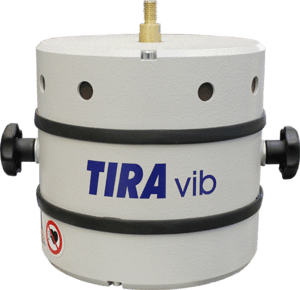
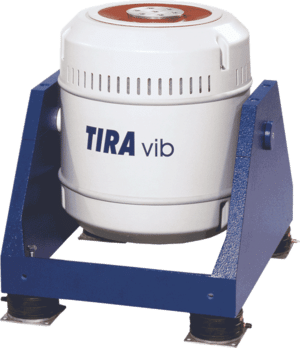
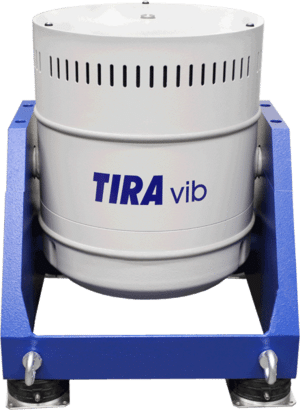
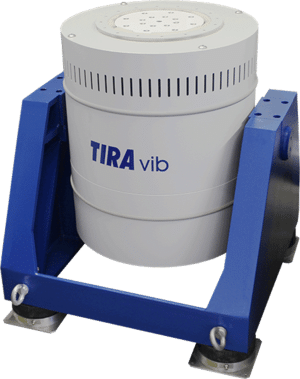
Inertial Exciters from 125 N to 650 N for Large Structures
The modal vibration test systems from TIRA are modal exciters for modal and structural analysis, with rated peak forces from 100 N to 15 kN. Each exciter applies a controlled dynamic force to the test structure through a coupling, and every model is supplied with a trunnion as standard, with a choice of coupling options.
Up to 400 N, the exciters use rare-earth permanent magnets, which keeps them light for mobile use; the 100 N TV 51110-M weighs 12 kg and covers DC to 5000 Hz. From 1000 N upwards, electronic zero-point control (TMC) provides up to 45 mm displacement, couples the exciter precisely to the test object and allows the axial stiffness to be adjusted electronically. The 4 kN to 15 kN models extend the displacement to 100 mm peak-to-peak for modal excitation of large structures or structures with high mass.
For mobile work, the TV 51120-MNC needs no additional cooling unit and the TV 51130-MSC has integrated air cooling. The MOSP models offer 25.4 mm displacement and a through hole in the armature for piano-wire stingers as well as push/pull stingers. Modal adapters also allow standard vibration exciters to be used for modal applications. Bestech Australia supplies the modal vibration test systems, backed by technical support from application engineers.
Key Features
- Rated peak force: 100 N to 15 kN (sine)
- Frequency range: DC to 5000 Hz up to 400 N; 1 to 2000 Hz from 4 kN to 15 kN
- Displacement: Up to 45 mm peak-to-peak from 1000 N; up to 100 mm from 4 kN
- Coupling and stiffness: Electronic zero-point control (TMC) with electronically adjustable axial stiffness
- Mobility: Exciters up to 400 N from 12 kg, with rare-earth magnets
Applications and Case Studies
- Modal and structural analysis
- Modal excitation of large structures or structures with high mass
- Mobile modal testing