
A part on a machine or a production line moves through a travel of a few tens of millimetres, and the engineer has to know where it is along that travel. The sensor also has to fit a tight space, withstand the plant environment and suit the volume being built. Our magneto-inductive sensors allow the automation or design engineer to measure the displacement and position of a part that carries a magnet, over measuring ranges from 14 to 55 mm, from an M12 stainless steel housing to a flat circuit board sensor for high-volume production.
Every instrument is selected on several testing and environmental parameters: the measuring range, the installation space and the production volume. To help you achieve these objectives, our in-house applications engineers can help you define the project scope and application, select the equipment, and assist with system integration and technical support.
What Is a Magneto-Inductive Sensor?
A magneto inductive sensor measures displacement and position from a magnet. The magnet is fixed to the object being measured and acts as a tracer. The sensor detects the position of that magnet, and so the position of the object.
A magneto-inductive sensor can also measure the rotational speed of shafts and gear wheels. It is widely used in factory automation and in the packaging industry. Magnets of different strengths give measuring ranges up to 55 mm, so a different range needs a different magnet, not a different sensor. No calibration is required when the sensor is installed.
How Magneto-Inductive Sensors Work
The magnet is attached to the moving object, and the sensor is mounted in a fixed position. The sensor measures the distance from its sensing element to the magnet. When the object moves, that distance changes, and the change alters the magnetic flux in the sensor element.
The sensor coil detects this change in flux and the sensor outputs a signal that follows the position of the magnet. The sensitivity at the end of the measuring range stays constantly high, so the signal remains usable across the whole travel.
In a harsh environment, the sensor can be housed separately from the magnet in a clean area. The magnet stays on the moving part, and the sensor is kept out of the process.
Magneto-Inductive Displacement Measurement
A magneto inductive displacement sensor gives a continuous analog signal over its measuring range, not a single switching point. From that signal, an engineer can generate as many switching points as the application needs, and the same signal also gives the actual position for a controller or data acquisition system to log. The MDS-45 series, for example, gives 2 to 9.6 V on the voltage versions and 4 to 19.2 mA on the current versions.
A magneto-inductive displacement sensor can measure through non-ferromagnetic objects such as aluminium or stainless steel. A magneto inductive position sensor can therefore sit behind a wall, with the magnet moving on the other side. Flush installation in non-magnetic materials is also possible, which helps achieve a high protection class.
Key Features and Advantages
On the MDS-45 series of magneto inductive sensors, resolution is below 0.05% of full scale output (FSO) on the voltage versions, and linearity is below ±3% FSO. The sensors operate from 11.5 to 30 VDC and from -20 to +80 °C, with an IP67 protection class and a higher class available on request. They are specified for vibration of 20 g from 58 to 500 Hz. An IP69K option exists for food industry applications.
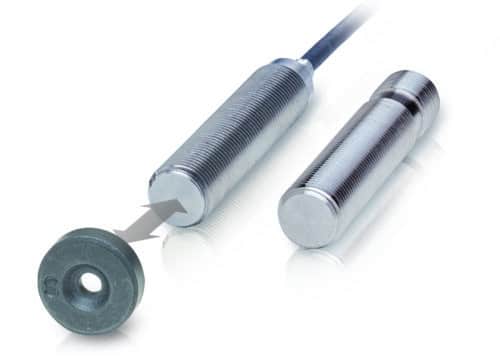
The MDS-45 is available in M18 and M30 stainless steel housings and in a flat plastic housing. The stainless steel housings suit demanding environments with dirt, oil and chemicals, and the food industry. The M12 versions suit restricted installation spaces, and the high temperature MDS-35-M12-HT measures at ambient temperatures up to 120 °C.
Measurement Range and Sensor Configuration
The measuring range of a magneto-inductive displacement sensor depends on the magnet, so the first selection step is to choose the magnet for the travel. With the MDS-45 series, standard magnets give measuring ranges from 20 to 55 mm: the MB20 magnet gives 20 mm, the MB45 gives 45 mm and the MB55 gives 55 mm. With the MDS-35 high temperature series, the same magnets give shorter ranges, down to 14 mm. To change the range, the engineer exchanges the magnet, and the sensor needs no adaptation or setup.
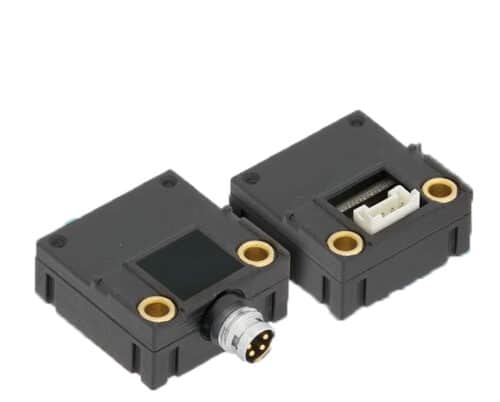
The MDS-35 and MDS-45 sensors come with a connector or an integrated cable, and the output is voltage or current. The MDS-40-MK series is modular, and its options include supply voltage (11 to 30 V, 5 V or 3.3 V), output (4 to 20 mA, 2 to 10 V, 0.5 to 4.5 V, 0.5 to 4.5 V ratiometric, or frequency), connector and protection class (IP67 casting or IP20). With the RL21 magnet, the MDS-40-MK measures 30 mm.
Two external conditions affect the result: external magnetic fields and ferromagnetic material in the measuring range change the sensor characteristic line and the technical data. We recommend checking the installation space for both before you choose.
Applications in Factory Automation and Packaging
Factory automation and packaging are the main application areas for these sensors, and they suit applications where large measuring ranges are required. A magneto inductive position sensor tracks the position of a moving machine part along a travel of up to 55 mm. Because the signal is continuous, the controller can set its own switching points.
The MDS-45 stainless steel housings suit dirt, oil and chemicals, and the IP69K option suits food industry applications. The same sensors measure the rotational speed of shafts and gear wheels, so one type of sensor can cover both position and speed on a machine.
OEM and High-Volume Applications
If you are designing a magneto inductive displacement sensor into your own product, the MDS-40 series is made for volume. The MDS-40-MK is pre-configured for high-volume applications in industry, and its options (supply, output, connector, protection class) can be combined from a quantity of 200 pieces. The magnet can be positioned on either side of the sensor, regardless of which pole faces the sensor.
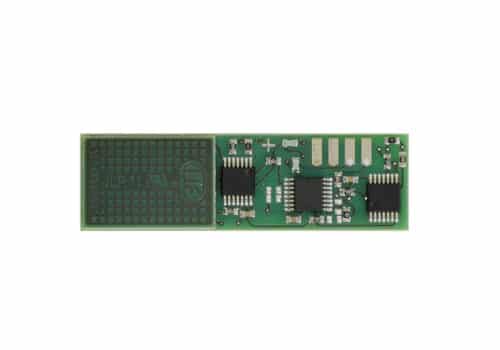
The MDS-40-LP goes further, with a flat circuit board design for large-volume production from 2,000 pieces. An example is integration into a washing machine damper. Its flat design and flexible magnet arrangement allow integration in restricted spaces, and the rectangular output signal is easy to read with the digital inputs of a microcontroller. These sensors can also be customised for specific requirements.
Magneto-Inductive Sensor Products
MDS-35 and MDS-45 industrial sensors
The MDS-45 is the standard version, in M18 and M30 stainless steel housings and a flat plastic housing, with a standard measuring range of 45 mm. The MDS-35 and MDS-45 M12 versions suit restricted spaces. The MDS-35-M12-HT measures 35 mm and operates at ambient temperatures up to 120 °C. Across the family, the measuring ranges run from 14 to 55 mm, with voltage or current outputs.
MDS-40-MK modular sensors
The MDS-40-MK series is pre-configured and modular, with measuring ranges from 23 to 50 mm. Outputs include voltage, current, mV/V and frequency. The linearity is below ±3% to ±5% FSO, the resolution is below 0.05% FSO, and the operating temperature is -20 to +80 °C.
MDS-40-LP circuit board sensors
The MDS-40-LP measures 40 mm on a flat circuit board, with a resolution below 0.05% FSO and an operating temperature of -20 to +85 °C. The supply is 3.6 to 5.3 VDC. Typical linearity is ±6% FSO for the MDS-40-LP-SUS and ±9% FSO for the MDS-40-LP-F, which are the example OEM models.
Frequently Asked Questions
What measuring range can one magneto-inductive sensor cover?
One magneto inductive sensor covers several ranges, because the magnet defines the measuring range. On the MDS-45 series, standard magnets give 20 to 55 mm. Tell us your travel and we can confirm the magnet and sensor combination.
Can a magneto-inductive sensor measure through a metal wall?
The sensor can measure through non-ferromagnetic objects such as aluminium or stainless steel. Ferromagnetic material in the measuring range affects the result, so tell us the wall material and thickness.
Do nearby magnetic fields or steel parts affect the measurement?
Yes. External magnetic fields and ferromagnetic material in the measuring range affect the sensor characteristic line and the technical data. Our engineers can assist with demonstration and testing in your own installation.
Can a magneto-inductive displacement sensor be configured for volume production?
The MDS-40-MK options can be combined from 200 pieces, and the MDS-40-LP is designed for large-volume production from 2,000 pieces. Tell us your volume, supply voltage and output signal, and we can discuss which series suits your product.
Tell us the travel, the installation space and the volume, and we will help you select the sensor. To start, have a chat with us about your application.
A part on a machine or a production line moves through a travel of a few tens of millimetres, and the engineer has to know where it is along that travel. The sensor also has to fit a tight space, withstand the plant environment and suit the volume being built. Our magneto-inductive sensors allow the automation or design engineer to measure the displacement and position of a part that carries a magnet, over measuring ranges from 14 to 55 mm, from an M12 stainless steel housing to a flat circuit board sensor for high-volume production.
Every instrument is selected on several testing and environmental parameters: the measuring range, the installation space and the production volume. To help you achieve these objectives, our in-house applications engineers can help you define the project scope and application, select the equipment, and assist with system integration and technical support.
What Is a Magneto-Inductive Sensor?
A magneto inductive sensor measures displacement and position from a magnet. The magnet is fixed to the object being measured and acts as a tracer. The sensor detects the position of that magnet, and so the position of the object.
A magneto-inductive sensor can also measure the rotational speed of shafts and gear wheels. It is widely used in factory automation and in the packaging industry. Magnets of different strengths give measuring ranges up to 55 mm, so a different range needs a different magnet, not a different sensor. No calibration is required when the sensor is installed.
How Magneto-Inductive Sensors Work
The magnet is attached to the moving object, and the sensor is mounted in a fixed position. The sensor measures the distance from its sensing element to the magnet. When the object moves, that distance changes, and the change alters the magnetic flux in the sensor element.
The sensor coil detects this change in flux and the sensor outputs a signal that follows the position of the magnet. The sensitivity at the end of the measuring range stays constantly high, so the signal remains usable across the whole travel.
In a harsh environment, the sensor can be housed separately from the magnet in a clean area. The magnet stays on the moving part, and the sensor is kept out of the process.
Magneto-Inductive Displacement Measurement
A magneto inductive displacement sensor gives a continuous analog signal over its measuring range, not a single switching point. From that signal, an engineer can generate as many switching points as the application needs, and the same signal also gives the actual position for a controller or data acquisition system to log. The MDS-45 series, for example, gives 2 to 9.6 V on the voltage versions and 4 to 19.2 mA on the current versions.
A magneto-inductive displacement sensor can measure through non-ferromagnetic objects such as aluminium or stainless steel. A magneto inductive position sensor can therefore sit behind a wall, with the magnet moving on the other side. Flush installation in non-magnetic materials is also possible, which helps achieve a high protection class.
Key Features and Advantages
On the MDS-45 series of magneto inductive sensors, resolution is below 0.05% of full scale output (FSO) on the voltage versions, and linearity is below ±3% FSO. The sensors operate from 11.5 to 30 VDC and from -20 to +80 °C, with an IP67 protection class and a higher class available on request. They are specified for vibration of 20 g from 58 to 500 Hz. An IP69K option exists for food industry applications.
The MDS-45 is available in M18 and M30 stainless steel housings and in a flat plastic housing. The stainless steel housings suit demanding environments with dirt, oil and chemicals, and the food industry. The M12 versions suit restricted installation spaces, and the high temperature MDS-35-M12-HT measures at ambient temperatures up to 120 °C.
Measurement Range and Sensor Configuration
The measuring range of a magneto-inductive displacement sensor depends on the magnet, so the first selection step is to choose the magnet for the travel. With the MDS-45 series, standard magnets give measuring ranges from 20 to 55 mm: the MB20 magnet gives 20 mm, the MB45 gives 45 mm and the MB55 gives 55 mm. With the MDS-35 high temperature series, the same magnets give shorter ranges, down to 14 mm. To change the range, the engineer exchanges the magnet, and the sensor needs no adaptation or setup.
The MDS-35 and MDS-45 sensors come with a connector or an integrated cable, and the output is voltage or current. The MDS-40-MK series is modular, and its options include supply voltage (11 to 30 V, 5 V or 3.3 V), output (4 to 20 mA, 2 to 10 V, 0.5 to 4.5 V, 0.5 to 4.5 V ratiometric, or frequency), connector and protection class (IP67 casting or IP20). With the RL21 magnet, the MDS-40-MK measures 30 mm.
Two external conditions affect the result: external magnetic fields and ferromagnetic material in the measuring range change the sensor characteristic line and the technical data. We recommend checking the installation space for both before you choose.
Applications in Factory Automation and Packaging
Factory automation and packaging are the main application areas for these sensors, and they suit applications where large measuring ranges are required. A magneto inductive position sensor tracks the position of a moving machine part along a travel of up to 55 mm. Because the signal is continuous, the controller can set its own switching points.
The MDS-45 stainless steel housings suit dirt, oil and chemicals, and the IP69K option suits food industry applications. The same sensors measure the rotational speed of shafts and gear wheels, so one type of sensor can cover both position and speed on a machine.
OEM and High-Volume Applications
If you are designing a magneto inductive displacement sensor into your own product, the MDS-40 series is made for volume. The MDS-40-MK is pre-configured for high-volume applications in industry, and its options (supply, output, connector, protection class) can be combined from a quantity of 200 pieces. The magnet can be positioned on either side of the sensor, regardless of which pole faces the sensor.
The MDS-40-LP goes further, with a flat circuit board design for large-volume production from 2,000 pieces. An example is integration into a washing machine damper. Its flat design and flexible magnet arrangement allow integration in restricted spaces, and the rectangular output signal is easy to read with the digital inputs of a microcontroller. These sensors can also be customised for specific requirements.
Magneto-Inductive Sensor Products
MDS-35 and MDS-45 industrial sensors
The MDS-45 is the standard version, in M18 and M30 stainless steel housings and a flat plastic housing, with a standard measuring range of 45 mm. The MDS-35 and MDS-45 M12 versions suit restricted spaces. The MDS-35-M12-HT measures 35 mm and operates at ambient temperatures up to 120 °C. Across the family, the measuring ranges run from 14 to 55 mm, with voltage or current outputs.
MDS-40-MK modular sensors
The MDS-40-MK series is pre-configured and modular, with measuring ranges from 23 to 50 mm. Outputs include voltage, current, mV/V and frequency. The linearity is below ±3% to ±5% FSO, the resolution is below 0.05% FSO, and the operating temperature is -20 to +80 °C.
MDS-40-LP circuit board sensors
The MDS-40-LP measures 40 mm on a flat circuit board, with a resolution below 0.05% FSO and an operating temperature of -20 to +85 °C. The supply is 3.6 to 5.3 VDC. Typical linearity is ±6% FSO for the MDS-40-LP-SUS and ±9% FSO for the MDS-40-LP-F, which are the example OEM models.
Frequently Asked Questions
What measuring range can one magneto-inductive sensor cover?
One magneto inductive sensor covers several ranges, because the magnet defines the measuring range. On the MDS-45 series, standard magnets give 20 to 55 mm. Tell us your travel and we can confirm the magnet and sensor combination.
Can a magneto-inductive sensor measure through a metal wall?
The sensor can measure through non-ferromagnetic objects such as aluminium or stainless steel. Ferromagnetic material in the measuring range affects the result, so tell us the wall material and thickness.
Do nearby magnetic fields or steel parts affect the measurement?
Yes. External magnetic fields and ferromagnetic material in the measuring range affect the sensor characteristic line and the technical data. Our engineers can assist with demonstration and testing in your own installation.
Can a magneto-inductive displacement sensor be configured for volume production?
The MDS-40-MK options can be combined from 200 pieces, and the MDS-40-LP is designed for large-volume production from 2,000 pieces. Tell us your volume, supply voltage and output signal, and we can discuss which series suits your product.
Tell us the travel, the installation space and the volume, and we will help you select the sensor. To start, have a chat with us about your application.
