

Prescale pressure sensing film (commonly known as pressure paper) is used to measure contact pressure and pressure distribution quickly and accurately. It provides a clear visual indication of pressure magnitude and uniformity, making it ideal for both laboratory testing and on-site inspection.
Prescale pressure indicating film is available in nine models, covering a wide range of applications from extremely low to super-high pressure ranges, with measurement capability from 0.006 MPa up to 300 MPa. The film is simple to use and requires no electronic devices or external power sources.
As an authorised supplier of Fuji Prescale film in Australia, Bestech provides technical guidance to ensure correct range selection and accurate interpretation of results.
For reliable results, it is recommended that the pressure paper test be read within 30 to 60 minutes after pressure application. The colour density increases gradually after loading and then slowly fades over time, allowing users to capture and interpret pressure distribution accurately.
Prescale pressure indicating film is available in nine models, covering a wide range of applications from extremely low to super-high pressure ranges, with measurement capability from 0.006 MPa up to 300 MPa. The film is simple to use and requires no electronic devices or external power sources.
As an authorised supplier of Fuji Prescale film in Australia, Bestech provides technical guidance to ensure correct range selection and accurate interpretation of results.
For reliable results, it is recommended that the pressure paper test be read within 30 to 60 minutes after pressure application. The colour density increases gradually after loading and then slowly fades over time, allowing users to capture and interpret pressure distribution accurately.
Highlights:
- Easy visual verification of pressure distribution and contact uniformity
- Cost-effective solution with no specialised equipment required
- Fast testing with clear, at-a-glance results
- Pressure intensity displayed through varying colour concentrations, which can be converted into numerical values

| Film types: | Mono-sheet or Two-sheet |
| Measurable pressure range: | 0.05 ~ 300 MPa (7.25 ~ 43, 500 psi) |
| Product size: | Effective width: 310 mm x 3 m |
| Accuracy: | ±10% or less (measured by densitometer at 23°C, 65% RH) |
| Recommended service temperature: | 20 ~ 35°C (68 ~ 95°F) or 180℃* on request |
| Recommended service humidity: | 35% RH ~ 80% RH |
Pressure is detected and visualised through colour density using pressure sensing film, also commonly referred to as pressure paper. The operating principle is based on microencapsulated colour technology. When the required level of pressure is applied, microscopic capsules rupture and produce a colour imprint on the colour-developing film.
The intensity of the colour formed is directly proportional to the magnitude of the applied pressure. This makes pressure indicating film an effective solution for visualising contact pressure, load distribution, and uniformity across a surface.
PRESCALE is widely recognised as pressure indicating film, pressure sensitive film, tactile pressure paper, and pressure measurement film. It is available in multiple formats, including Fuji Prescale film, pressure tape, and pressure paper, to suit a broad range of applications.
 During a pressure paper test, the matte-coated sides of both films must face each other. When pressure is applied, the microcapsules break and react with the colour-developing layer, producing a red colour. The resulting colour density corresponds to the applied pressure level.
 Mono-sheet type Prescale film is suitable for medium to super-high pressure ranges and requires only a single sheet. In this format, both the colour-forming and colour-developing materials are coated in layers on a PET base, simplifying placement while maintaining accuracy.

 Note: Avoid touching the coated side of the A-Film for two-sheet types, as contact may rupture the microcapsules and transfer colour-forming material to the skin.
The intensity of the colour formed is directly proportional to the magnitude of the applied pressure. This makes pressure indicating film an effective solution for visualising contact pressure, load distribution, and uniformity across a surface.
PRESCALE is widely recognised as pressure indicating film, pressure sensitive film, tactile pressure paper, and pressure measurement film. It is available in multiple formats, including Fuji Prescale film, pressure tape, and pressure paper, to suit a broad range of applications.
Film Structure and Measurement Method
Two-sheet type PRESCALE films, designed for ultra-low to medium pressure measurement, consist of:- A-Film: PET base coated with colour-forming microcapsules
- C-Film: PET base coated with colour-developing material
During a pressure paper test, the matte-coated sides of both films must face each other. When pressure is applied, the microcapsules break and react with the colour-developing layer, producing a red colour. The resulting colour density corresponds to the applied pressure level.
Mono-sheet type Prescale film is suitable for medium to super-high pressure ranges and requires only a single sheet. In this format, both the colour-forming and colour-developing materials are coated in layers on a PET base, simplifying placement while maintaining accuracy.
Colour Development and Analysis
When pressure is applied, the colour-forming material reacts chemically with the colour-developing layer, creating a red coloration that represents pressure distribution. The darker the colour, the higher the pressure applied. The resulting pressure impression can be digitised using a scanner and analysed with compatible software, enabling pressure values to be converted into quantitative data for reporting, quality assurance, and process optimisation.
Note: Avoid touching the coated side of the A-Film for two-sheet types, as contact may rupture the microcapsules and transfer colour-forming material to the skin.
Nip pressure measurement
A: Calender rolls (Paper)
 B: Rubber roller mounting (Printed circuit boards / Electronics)
 C: Size Press Rubber Rolls
 Roll/Plate Contract PressureA: Backgrind Tape Lamination Roller
 B: Electro-photographic heat fixing parts
 C: Cover glass attaching equipment
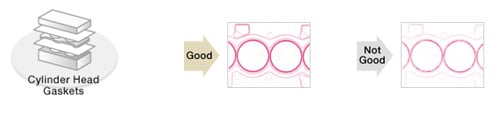
 Tightening Pressure of Fastened Parts
A: Cylinder Head Gaskets (Automobiles)
Tightening Pressure of Fastened Parts
A: Cylinder Head Gaskets (Automobiles)
 Contact Pressure
A: Brake pads
Contact Pressure
A: Brake pads
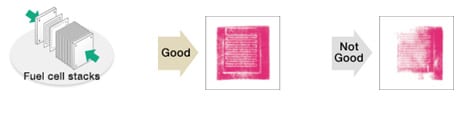
 Compression Pressure A: Vacuum laminator (Photo-voltaics)
 B: Wafer bonding equipment thermo-compression bonds
C: Fuel cell stacks
B: Wafer bonding equipment thermo-compression bonds
C: Fuel cell stacks
 Support Pressure
A: Tires and caterpillar tracks
Support Pressure
A: Tires and caterpillar tracks
 Winding Pressure
A: Roll product winding
Winding Pressure
A: Roll product winding
 Contact Conditions
A: Injection moulding machines, moulds (Office machines)
Contact Conditions
A: Injection moulding machines, moulds (Office machines)
 B: Heat sealing (Packaging)
Impact Pressure
B: Heat sealing (Packaging)
Impact Pressure
 B: Function testing of golf
C: Pressure on freight during transportation
D: Impact pressure on bumpers and airbags
B: Function testing of golf
C: Pressure on freight during transportation
D: Impact pressure on bumpers and airbags
 Medical
A: Pressure on soles of human feet and on soles of shoes
B: Cavitation pressure
C: Orthopaedics, ergonomics
D: Bone plate pressure, joint pressure
E: Tooth alignment and pressure, mastication analysis
F: Biomedical, forensic science
Medical
A: Pressure on soles of human feet and on soles of shoes
B: Cavitation pressure
C: Orthopaedics, ergonomics
D: Bone plate pressure, joint pressure
E: Tooth alignment and pressure, mastication analysis
F: Biomedical, forensic science
 Medical
 More examples, please visit here.
For more information, CONTACT US now with your application details.
More examples, please visit here.
For more information, CONTACT US now with your application details.
B: Rubber roller mounting (Printed circuit boards / Electronics)
C: Size Press Rubber Rolls
Roll/Plate Contract PressureA: Backgrind Tape Lamination Roller
B: Electro-photographic heat fixing parts
C: Cover glass attaching equipment
Tightening Pressure of Fastened Parts
A: Cylinder Head Gaskets (Automobiles)
Contact Pressure
A: Brake pads
Compression Pressure A: Vacuum laminator (Photo-voltaics)
B: Wafer bonding equipment thermo-compression bonds
C: Fuel cell stacks
Support Pressure
A: Tires and caterpillar tracks
Winding Pressure
A: Roll product winding
Contact Conditions
A: Injection moulding machines, moulds (Office machines)
B: Heat sealing (Packaging)
Impact Pressure
B: Function testing of golf
C: Pressure on freight during transportation
D: Impact pressure on bumpers and airbags
Medical
A: Pressure on soles of human feet and on soles of shoes
B: Cavitation pressure
C: Orthopaedics, ergonomics
D: Bone plate pressure, joint pressure
E: Tooth alignment and pressure, mastication analysis
F: Biomedical, forensic science
Medical
- A: Pressure on soles of human feet and on soles of shoes
- B: Cavitation pressure
- C: Orthopaedics, ergonomics
- D: Bone plate pressure, joint pressure
- E: Tooth alignment and pressure, mastication analysis
- F: Biomedical, forensic science
More examples, please visit here.
For more information, CONTACT US now with your application details.
